Your massive hot water tank is taking up half your airing cupboard, and you’re wondering if one of those neat combi boilers might be a better option. Here’s everything you need to know before making the switch.
Let’s talk about that enormous hot water cylinder currently living rent-free in your airing cupboard. It’s been there since your house was built in 1987, taking up valuable storage space that could be holding towels, bedding, or all those “useful” things you can’t quite bring yourself to throw away. Meanwhile, half your loft is occupied by a huge header tank, and you’ve got to wait ages for hot water to arrive at upstairs taps.
You’ve heard about combi boilers. Your mate Dave got one fitted and now he’s got instant hot water and a whole extra cupboard’s worth of storage. “Best thing we ever did,” he says. “Should’ve done it years ago.” But then your neighbour mentions her combi struggles when both showers are running, and you’re left confused about whether a combi is actually right for you.
Converting from a conventional or system boiler to a combi is one of the most popular heating upgrades in the UK. When it works well, it’s brilliant. When it’s wrong for your property, it’s expensive disappointment. The trick is understanding whether a combi suits your specific situation before you spend £2,000-£4,000 finding out.
This guide walks you through everything you need to know – what combi boilers actually do differently, who they work brilliantly for (and who they don’t), what conversion involves, realistic costs for 2025, potential complications, and how to know if you’re making the right choice. By the end, you’ll know whether converting to a combi makes sense for your home or whether you’d be better off sticking with what you’ve got.
Understanding the Different Boiler Types
Before we talk about conversion, let’s clarify what the different boiler types actually do. Most homeowners haven’t got a clue (why would you?), but understanding this is crucial to making the right decision.
What You Probably Have Now: Conventional (Regular) Boilers
How they work: Your boiler heats water, which is stored in a hot water cylinder (usually in an airing cupboard). You’ve also got a header tank in the loft feeding the cylinder and possibly radiators. Hot water comes from the cylinder, radiators are fed from the boiler via the cylinder or separately.
Components:
- Boiler (heats the water)
- Hot water cylinder (stores heated water)
- Header tank in loft (cold water storage)
- Expansion tank in loft (takes up pressure changes)
- Lots of pipework connecting everything
Advantages:
- Great for properties with multiple bathrooms
- Can supply hot water to several outlets simultaneously
- Compatible with power showers
- Works with low mains pressure
- Proven, reliable technology
Disadvantages:
- Takes up loads of space (cylinder and tanks)
- Water can run out (empty cylinder = no hot water)
- Heat loss from stored hot water
- More complex system with more potential failure points
- Slower to heat water initially
The Alternative: Combi (Combination) Boilers
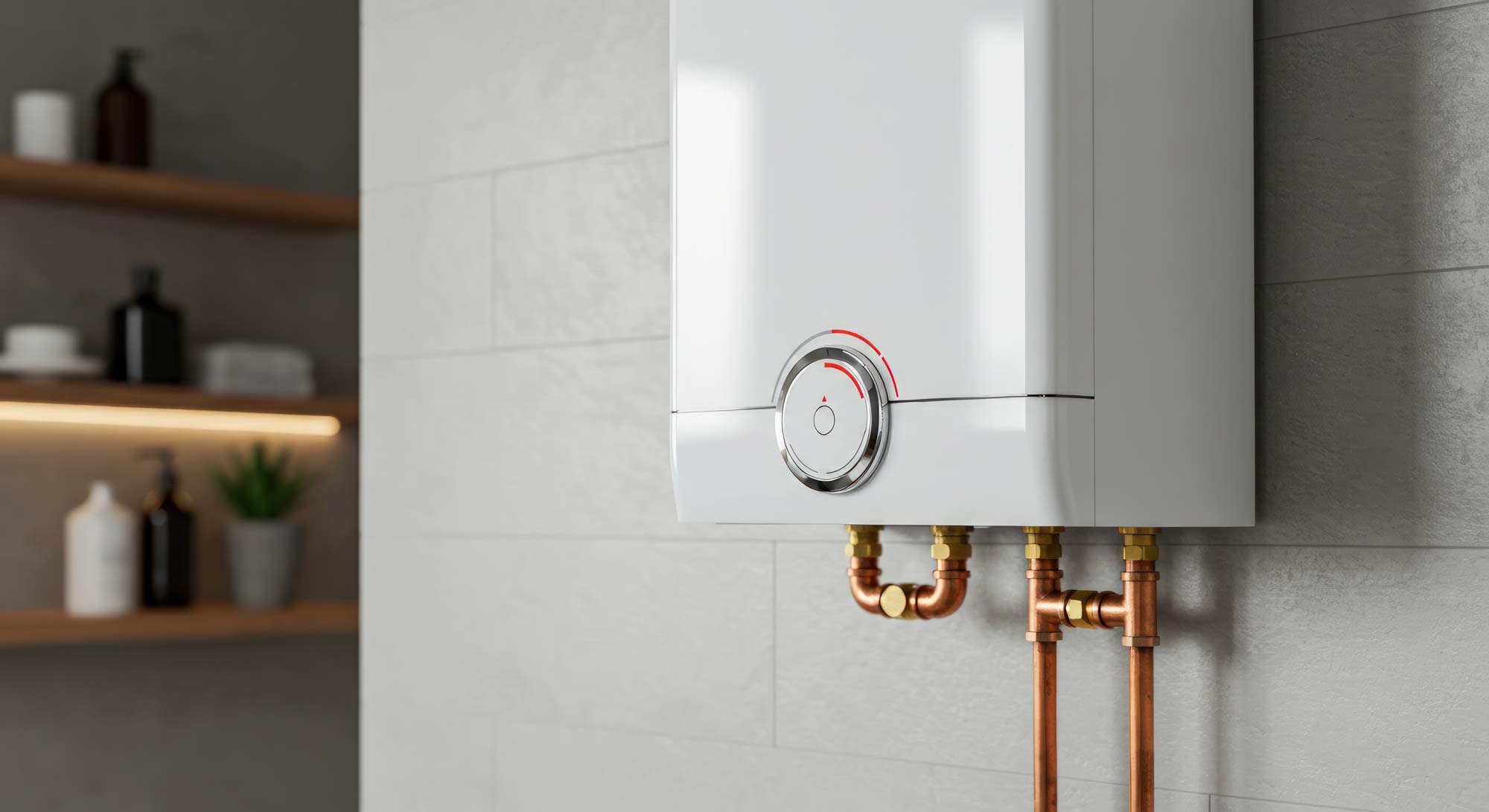
How they work: One box does everything. The boiler heats water instantly as you open a tap, providing both central heating and hot water on demand. No cylinder, no header tanks, no water storage.
Components:
- Just the combi boiler
- Expansion vessel (usually built into boiler)
- Much simpler pipework
Advantages:
- Instant hot water (no waiting for cylinder to heat)
- Space-saving (no cylinder or tanks)
- Only heat what you use (potentially more efficient)
- Mains pressure hot water (strong flow)
- Simpler system (fewer components to fail)
- Lower installation cost for new builds
Disadvantages:
- Flow rate limited by boiler capacity and mains pressure
- Struggles with simultaneous hot water use (two showers at once is often poor)
- Requires decent mains water pressure (minimum 1-1.5 bar)
- Can’t run power showers
- No backup if boiler fails (with cylinders, you can use immersion heater)
System Boilers: The Middle Ground
How they work: Similar to conventional boilers but with some components built into the boiler itself. Still need a cylinder for hot water storage but no header tank in the loft.
Why we’re mentioning them: Some properties suit system boilers better than combis. If you’ve got multiple bathrooms but want to lose the loft tanks, this might be your sweet spot rather than going full combi.
Is Your Home Suitable for a Combi Boiler?
This is the crucial question. Combis are brilliant for some properties and terrible for others. Here’s how to know which camp you’re in.
Properties Perfect for Combis
You’re an ideal candidate if:
Small to medium property:
- 1-3 bedrooms
- 1 bathroom (or 1 bathroom plus an en-suite used infrequently)
- Modest heating requirements
Low simultaneous hot water use:
- You don’t have multiple people showering at the same time
- Washing machine and dishwasher don’t often run whilst someone’s showering
- Maximum 1-2 hot water outlets in use simultaneously
Good mains water pressure:
- Test your pressure: run kitchen cold tap full blast whilst someone flushes toilet
- If tap flow barely changes, you’re fine
- If tap flow drops significantly, combi might struggle
- Minimum 1.5 bar pressure ideal, 1 bar absolute minimum
Modern property with decent pipework:
- 22mm incoming mains supply (not 15mm)
- Good quality internal pipework
- No major distance between boiler and outlets
Small household:
- 1-2 people
- Limited peak-time hot water conflicts
Example ideal household: Young couple in 2-bed flat. One bathroom. Good water pressure. Both work full-time so limited overlap in water use. Rarely use hot water simultaneously.
Verdict: Combi will be brilliant for you.
Properties Where Combis Struggle
You’re NOT a good candidate if:
Large property:
- 4+ bedrooms
- 2+ bathrooms (especially if both are used regularly)
- Large house means long pipe runs reducing pressure further
High simultaneous hot water demand:
- Multiple teenage children showering at the same time every morning
- Running dishwasher, washing machine, and shower simultaneously
- 3+ people getting ready for work/school at same time
Poor water pressure:
- Existing mains pressure is weak
- Shared supply with neighbours
- Rural property at end of long supply pipe
- Upstairs taps currently weak
Property needs power showers:
- You’ve got pumped showers you love
- Combis cannot run power showers (they detect the pump and shut off for safety)
Large hot water requirements:
- You regularly fill large baths
- Multiple long showers back-to-back
- High-volume hot water use
Example problematic household: Family of five in 4-bed house. Three teenagers showering before school every morning. Two bathrooms in constant use. Poor water pressure. Combi would be a disaster.
Verdict: Stick with cylinder system or upgrade to larger cylinder with system boiler.
The “Maybe” Zone: Needs Careful Consideration
You might be suitable but need to check if:
3-bedroom house with 2 bathrooms:
- Depends heavily on usage patterns
- Could work if one bathroom is rarely used
- Definitely check mains pressure first
- Consider larger combi boiler (35kW+)
Moderate family (2 adults, 1-2 children):
- Depends on morning routines
- If you can stagger showers, combi works
- If everyone showers simultaneously, cylinder is better
Properties with power showers:
- You’ll lose power showers if you convert to combi
- For some people, this is a deal-breaker
- Consider very carefully if you love your power shower
What’s Involved in Converting to a Combi
Understanding the conversion process helps you budget accurately and plan for disruption.
Survey and Assessment
Before any work starts, a Gas Safe heating engineer should survey your property properly.
What they check:
- Mains water pressure (critical for combi performance)
- Incoming pipe size (15mm, 22mm, or 25mm)
- Gas supply adequacy (combis need higher gas flow rate)
- Existing pipework condition and layout
- Best location for new combi boiler
- Radiator sizes and system volume
Red flags they might find:
- Inadequate water pressure (below 1 bar)
- Undersized incoming mains supply (15mm)
- Insufficient gas supply
- Property simply too large for combi
Good engineers will tell you if a combi isn’t suitable. Cowboys will sell you one anyway and take your money.
The Conversion Work
Day 1: Removal and first fix
Remove old system:
- Drain down system completely
- Remove old boiler (potentially back boiler if you’ve got one)
- Remove hot water cylinder
- Drain and remove header tanks from loft
- Cap off redundant pipework
First fix new system:
- Position new combi boiler
- Install new flue (potentially different position than old one)
- Connect to gas supply (might need upgrading)
- Connect to mains cold water supply
- Install new pipework as needed
- Fit filling loop and pressure gauge
Day 2: Second fix and commissioning
Complete installation:
- Connect radiator pipework to combi
- Wire up electrical connections
- Fit controls (thermostat, timer/programmer)
- Pressure test entire system
- Fill system and check for leaks
- Commission boiler
- Test all radiators and hot water outlets
- Balance radiators
Additional work (if needed):
- Install water softener if you’re in hard water area (prolongs combi life)
- Fit magnetic filter to protect combi from system debris
- Power flush system if radiators are dirty (highly recommended)
- Upgrade main stop tap if inadequate
Timeline:
- Simple conversion: 1-2 days
- Complicated conversion: 2-3 days
- Additional complications: 3-4 days
What Happens to Old Components
Hot water cylinder: Removed and disposed of. Some engineers will leave it for you to dispose of if you prefer (saves them disposal costs, but you’re left with a massive cylinder to get rid of).
Header tanks: Removed from loft. This frees up valuable loft space.
Airing cupboard: Now empty! You’ve gained storage space. Many people convert to actual cupboard space or fit a washing machine in there.
Old boiler: Removed and disposed of responsibly (there are environmental regulations about this).
Pipework: Redundant pipes are usually capped off and left in place (removing them entirely would require opening up walls and floors).
Costs of Converting to a Combi Boiler (2025)
Right, let’s talk money. This is a significant investment, so understanding costs is crucial.
Basic Conversion Costs
England (excluding London):
- Budget combi boiler conversion: £1,800-£2,500
- Mid-range combi boiler conversion: £2,200-£3,200
- High-end combi boiler conversion: £2,800-£4,000
London and South East:
- Budget conversion: £2,400-£3,200
- Mid-range conversion: £2,800-£4,000
- High-end conversion: £3,500-£5,000
Scotland:
- Budget conversion: £1,700-£2,400
- Mid-range conversion: £2,100-£3,000
- High-end conversion: £2,600-£3,800
Wales:
- Budget conversion: £1,700-£2,400
- Mid-range conversion: £2,100-£3,100
- High-end conversion: £2,700-£3,900
Northern Ireland:
- Budget conversion: £1,600-£2,300
- Mid-range conversion: £2,000-£2,900
- High-end conversion: £2,500-£3,700
What’s included:
- New combi boiler
- Removal of old system (boiler, cylinder, tanks)
- Basic pipework alterations
- New flue
- Controls (thermostat, programmer)
- Commissioning and testing
- Building regulations notification
- Warranty registration
What Affects the Price?
Boiler quality and size:
Budget combis (£600-£1,000):
- Lesser-known brands (Potterton, Ideal Logic)
- Shorter warranties (2-5 years)
- Lower output (24-30kW)
Mid-range combis (£1,000-£1,800):
- Established brands (Worcester Bosch, Vaillant, Baxi)
- Good warranties (5-7 years)
- Range of outputs (28-35kW)
Premium combis (£1,800-£2,500):
- Top brands (Worcester Bosch Greenstar, Vaillant ecoTEC)
- Extended warranties (7-10 years)
- High outputs (35-42kW)
- Better build quality and reliability
Installation complexity:
Simple installation (lower cost):
- Easy access to boiler location
- Existing pipework suitable
- Straightforward flue route
- No additional work needed
Complex installation (higher cost):
- Difficult access (cellar, tight spaces)
- Major pipework alterations needed
- Complicated flue installation
- Back boiler removal (adds £200-£400)
- Asbestos around old boiler (removal required: £500-£1,500)
System condition:
Clean system (lower cost):
- Recent radiators in good condition
- Relatively clean heating water
- Modern pipework
Dirty system (higher cost):
- Old radiators full of sludge
- Black heating water
- Corroded pipework
- Needs power flush (adds £300-£600)
- Might need radiator replacement (£100-£250 each)
Hidden Costs to Budget For
These often catch people out:
Gas supply upgrade: If your existing gas pipe is undersized for a combi’s flow rate requirements, upgrading costs £300-£800.
Electrical work: If you need a new electrical spur for the boiler or upgraded wiring, that’s £150-£400 with an electrician.
Water supply upgrade: If your incoming mains is inadequate 15mm pipe, upgrading to 22mm costs £400-£1,200 depending on distance from boundary.
Radiator upgrades: Combis run at lower temperatures than old boilers. Your existing radiators might be undersized for combi efficiency. Expect £100-£250 per radiator to upgrade.
Magnetic filter: Essential for combi longevity (protects from system debris). Costs £80-£150 but should be included in any decent installation.
Smart controls: Basic controls are included, but smart thermostats (Nest, Hive, Tado) cost £150-£300 extra.
Making good: If walls or floors need opening for pipework, making good costs £200-£600 depending on extent.
Total potential extras: £500-£3,000 on top of basic conversion cost.
Finance and Grants
Boiler financing: Most boiler installation companies offer finance at 0% APR over 2-5 years. Monthly payments typically £50-£100.
Government grants: The ECO4 scheme provides grants for low-income households. Eligibility criteria are strict, but if you qualify, you might get a free or heavily subsidised boiler replacement.
Check eligibility: Contact Energy Saving Trust on 0300 123 1234
Benefits of Converting to a Combi
Why do people make this switch? Here are the genuine advantages.
Space Liberation
What you gain:
- Airing cupboard freed up (1-2 cubic metres storage)
- Loft space freed up (0.5-1 cubic metre)
- Total: Equivalent to adding a medium cupboard to your home
Real value: In space-constrained properties, this is genuinely valuable. Many people convert airing cupboards to:
- Utility space (washing machine, dryer)
- Additional storage
- Small home office
- Shoe storage
In a London flat? This space gain is worth hundreds or even thousands in property value terms.
Instant Hot Water
No more waiting: With a cylinder system, hot water takes minutes to arrive at upstairs taps (the water in the pipes cools down between uses). Combis provide instant hot water at any tap.
Water savings: You’re not running taps waiting for hot water, wasting litres down the drain. Meaningful savings over time, especially if you’re metered.
Convenience: Morning routine becomes faster. No pre-heating cylinder before showers.
Energy Efficiency Gains
Modern combis are more efficient than old boilers:
- New combi: 90-94% efficiency
- 15-year-old conventional boiler: 65-75% efficiency
- 25-year-old boiler: 55-65% efficiency
Savings on energy bills:
- Upgrading from 20-year-old boiler: £300-£500 annually
- Upgrading from 10-year-old boiler: £150-£250 annually
- Actual savings depend on usage patterns and insulation
Why combis can be more efficient:
- No heat loss from stored hot water
- No keeping cylinder hot overnight
- Modern condensing technology
- Only heat what you use
Reality check: Efficiency gains are real but don’t expect miracles. A well-insulated house with thoughtful usage patterns will see better returns than a draughty house where everyone takes 20-minute showers.
Mains Pressure Hot Water
What this means: Hot water comes out at mains pressure (1.5-4 bar typically), rather than gravity-fed pressure from header tank (0.1-0.5 bar).
Benefits:
- Better shower experience (stronger flow)
- Baths fill faster
- Dishwashers and washing machines work better
- Kitchen tap flow is noticeably better
Caveat: Only true if your mains pressure is decent to begin with. If you’ve got poor mains pressure (below 1 bar), this benefit evaporates.
Simplified System
Fewer components mean:
- Fewer things to go wrong
- Simpler servicing
- No legionella risk (stored water can harbour bacteria; combis don’t store water)
- No frozen header tank issues in winter
Lower maintenance: Cylinders eventually need replacing (lifespan 10-20 years, cost £500-£1,500). Combis eliminate this future expense.
Drawbacks of Converting to a Combi
Balance time. Here’s what you lose or might struggle with.
Limited Simultaneous Hot Water
The big limitation: Combis can only heat water at a certain rate. If two outlets demand hot water simultaneously, both suffer reduced flow or temperature.
Real-world impact:
24kW combi (small):
- One shower running: Fine
- Two showers running: Both lukewarm and weak
30kW combi (medium):
- One shower running: Good
- Two showers running: Adequate but noticeably reduced
- Shower + dishwasher: Shower affected
35kW+ combi (large):
- One shower running: Excellent
- Two showers running: Usable but both reduced
- Shower + dishwasher: Manageable
With cylinder system: Multiple showers run independently from stored hot water. No performance loss until cylinder empties.
Workarounds:
- Stagger shower times
- Choose larger output combi (35kW+)
- Accept the limitation if simultaneous use is rare
No Backup Hot Water
If combi breaks down: You have no hot water whatsoever. Nothing. Not even from immersion heater because there isn’t a cylinder.
With cylinder system: Boiler breaks? Switch to immersion heater. Still have hot water (albeit expensive to run).
Reality check: Modern combis are reliable, but when they fail, you’re completely without hot water until repaired. In winter, this can be extremely inconvenient.
Solution: Choose reliable brand with good warranty. Keep a good heating engineer’s number handy. Budget for boiler cover (£10-£30 monthly) if breakdown worries you.
Power Showers Become Impossible
If you love power showers: Combis detect the pump and shut off (safety feature). You cannot run a pumped power shower with a combi.
Your options:
- Accept mains-pressure shower instead (might be fine if pressure is good)
- Don’t convert to combi if power shower is non-negotiable
- Install high-flow shower head to maximise available pressure
For some people, this is the deal-breaker. If your amazing power shower is part of your daily joy, think very carefully before giving it up.
Dependent on Good Water Pressure
If mains pressure drops: Your combi’s performance drops proportionally. This can happen due to:
- Maintenance work by water company
- Burst mains in your area
- Peak demand times
- New housing developments increasing local demand
With tank-fed system: You’ve got stored water. Mains pressure fluctuations don’t affect hot water delivery.
Mitigation: Most of the time, mains pressure is fine. But if you live somewhere with notoriously unreliable mains, this is worth considering.
Common Conversion Problems and How to Avoid Them
These issues trip up many people. Learn from their expensive mistakes.
Problem 1: Inadequate Mains Pressure
The situation: Engineer installs combi. You’re excited. Turn on shower. Pathetic dribble. Engineer says, “Your mains pressure is too low for combi.”
Why it happens:
- Mains pressure wasn’t properly tested before conversion
- Mains pressure was borderline and has since worsened
- Incoming pipework is undersized (15mm instead of 22mm)
Prevention:
- Insist on proper pressure testing during survey (not just “turned on a tap and it seemed fine”)
- Ask engineer: “What’s my measured mains pressure, and is that adequate?”
- If pressure is borderline (1-1.2 bar), seriously reconsider
If it happens:
- Pressure accumulator can help (£300-£800)
- Upgrading incoming pipework helps (£500-£1,500)
- In worst cases, might need to convert back to cylinder (expensive disaster)
Problem 2: Wrong Size Combi Chosen
The situation: Engineer recommends 24kW combi for your 4-bed house with 2 bathrooms. You agree because it’s cheapest. Performance is disappointing.
Why it happens:
- Underselling by engineer to win business on price
- Inadequate property assessment
- You chose cheapest option without understanding implications
Prevention:
- Ask specifically about hot water flow rate (litres per minute)
- Explain your usage patterns honestly
- For 2+ bathrooms, insist on 30kW minimum, preferably 35kW+
If it happens:
- Manage expectations and usage patterns
- Consider upgrading to larger combi (expensive: another £1,500-£2,500)
Problem 3: System Not Power Flushed
The situation: Shiny new combi installed. Works brilliantly for 6 months. Then starts playing up. Engineer says heat exchanger is clogged with system debris. Not covered by warranty (you didn’t power flush).
Why it happens:
- Engineer cut corners to reduce price
- You declined power flush to save money
- Existing system was filthy (black water) but installed anyway
Prevention:
- If heating water is anything other than clear, insist on power flush before combi installation
- Budget £300-£600 for power flush if needed
- It’s cheap insurance for a £2,000+ investment
If it happens:
- Power flush now (£300-£600)
- Heat exchanger cleaning or replacement (£200-£600)
- Could have been avoided entirely with pre-flush
Problem 4: No Magnetic Filter Fitted
The situation: Two years after installation, combi develops faults. Engineer finds system debris has damaged components. No magnetic filter was fitted to protect it.
Why it happens:
- Engineer saved £80-£150 by not fitting filter
- You didn’t know to ask about it
Prevention:
- Ask specifically: “Are you fitting a magnetic filter?”
- It should be standard in any decent installation
- Costs £80-£150, saves hundreds in future repairs
If it happens:
- Fit filter now (£80-£150)
- Cross fingers that damage hasn’t already occurred
Problem 5: Boiler Positioned Poorly
The situation: Combi is installed in garage or external location. Works fine in summer, then winter arrives and boiler keeps freezing and shutting down.
Why it happens:
- Convenience of installation prioritised over practical considerations
- Inadequate frost protection
Prevention:
- Internal boiler location preferable where possible
- If external location necessary, ensure robust frost protection
- Insulate pipework properly
If it happens:
- Improve insulation and frost protection (£200-£500)
- Consider boiler relocation (£500-£1,500)
Making Your Decision: Is Combi Conversion Right for You?
Let’s bring this all together with a decision framework.
Run Through This Checklist
Answer yes or no to each question:
- Do you have 1-2 bathrooms maximum? ___
- Are simultaneous hot water uses rare in your household? ___
- Is your mains water pressure good (1.5 bar+)? ___
- Is your property small to medium sized (1-3 bedrooms)? ___
- Would you benefit from freeing up space (cylinder/tanks)? ___
- Is your current boiler old (15+ years) and due for replacement? ___
- Are you willing to lose power showers? ___
- Can your household adapt to staggered shower times if needed? ___
Scoring:
- 7-8 yes: Combi is probably brilliant for you
- 5-6 yes: Combi could work but consider carefully
- 3-4 yes: Probably stick with cylinder system or upgrade to system boiler
- 0-2 yes: Don’t convert to combi
Alternative: System Boiler Upgrade
If your score was middle-ground, consider upgrading to a modern system boiler instead:
Benefits:
- Keep hot water cylinder (multiple outlets work simultaneously)
- Lose header tanks in loft (space saving)
- Modern efficiency (90%+)
- Mains-pressure hot water if you fit unvented cylinder
- Better for larger properties
Costs: Similar to combi conversion (£2,000-£4,000), sometimes slightly more for unvented cylinder.
Best for: Properties that need cylinder capacity but want to modernise and lose loft tanks.
Finding the Right Installer
This is a major investment. Choose your installer carefully.
Essential Qualifications
Must-haves:
- Gas Safe registration (absolute non-negotiable)
- Specific boiler brand training certificates (most manufacturers offer these)
- Public liability insurance (£2 million minimum)
- Good local reputation and reviews
Check Gas Safe registration: Every installer should carry a Gas Safe ID card. Verify their registration online at www.gassaferegister.co.uk before any work begins.
Using Trader Street
Search “local plumber near me UK” on Trader Street, specifically looking for Gas Safe heating engineers who specialise in combi conversions.
What to look for:
- Reviews mentioning combi installations
- Photos of completed conversions
- Clear explanation of what’s included in quotes
- Willingness to assess property properly before quoting
Questions to ask:
- “Will you assess my mains water pressure properly?”
- “What size combi do you recommend for my property and why?”
- “Do you include power flush and magnetic filter?”
- “Which brands do you recommend and what warranties do they offer?”
- “How long will conversion take?”
- “What’s your guarantee on the installation work?”
- “Can you provide references from recent combi conversions?”
Red flags:
- Pressure to decide immediately
- Vague about mains pressure requirements
- Won’t assess property before firm quote
- Quotes significantly cheaper than competitors (usually cutting corners)
- Can’t explain why they recommend specific boiler size
The Bottom Line: Combis Are Brilliant But Not Universal
Here’s the honest truth: combi boilers are absolutely brilliant for the right properties and terrible for the wrong ones. The heating industry’s dirty secret is that far too many combis are installed in properties that aren’t suitable, leading to disappointed homeowners and wasted money.
Combis excel in:
- Small flats and houses
- 1-2 person households
- Properties with good mains pressure
- Situations with low simultaneous hot water demand
Combis struggle in:
- Large family homes
- Properties with multiple bathrooms in regular use
- Areas with poor water pressure
- Households with high peak-demand hot water use
The responsible approach:
- Get proper assessment of mains pressure (actual measurements, not guesswork)
- Honestly evaluate your household’s hot water usage patterns
- Listen if experienced engineer says combi isn’t suitable
- Consider system boiler upgrade if you’re borderline
- Choose reputable installer with Gas Safe registration
- Budget for power flush and magnetic filter
- Select appropriate size combi (don’t cheap out on undersized unit)
Cost reality: A properly specified and installed combi conversion costs £2,000-£4,000. Budget the full amount. Cutting corners to save £300-£500 usually leads to problems costing more to fix than you saved.
For households where combis work well, they’re genuinely transformative. Instant hot water, freed-up space, simplified system, good efficiency – all brilliant. But they’re not magic solutions for everyone.
If you’re honestly not sure whether a combi suits your property, consider a professional heating designer consultation (£100-£200) before committing to conversion. It’s cheap insurance against a £3,000 mistake.
And remember: Trader Street connects you directly with experienced Gas Safe heating engineers who can provide honest assessments and competitive quotes for combi conversions or alternative upgrades – without platform fees inflating your costs.
Your heating system is one of your home’s most important components. Get the upgrade right, and you’ll enjoy the benefits for 10-15 years. Get it wrong, and you’ll regret it every single morning in the shower. Choose wisely.
Considering converting to a combi boiler? Connect with experienced Gas Safe heating engineers on Trader Street for honest assessments, competitive quotes, and professional installations. Read reviews from neighbours, compare approaches, and arrange consultations directly – ensuring you make the right choice for your property.