
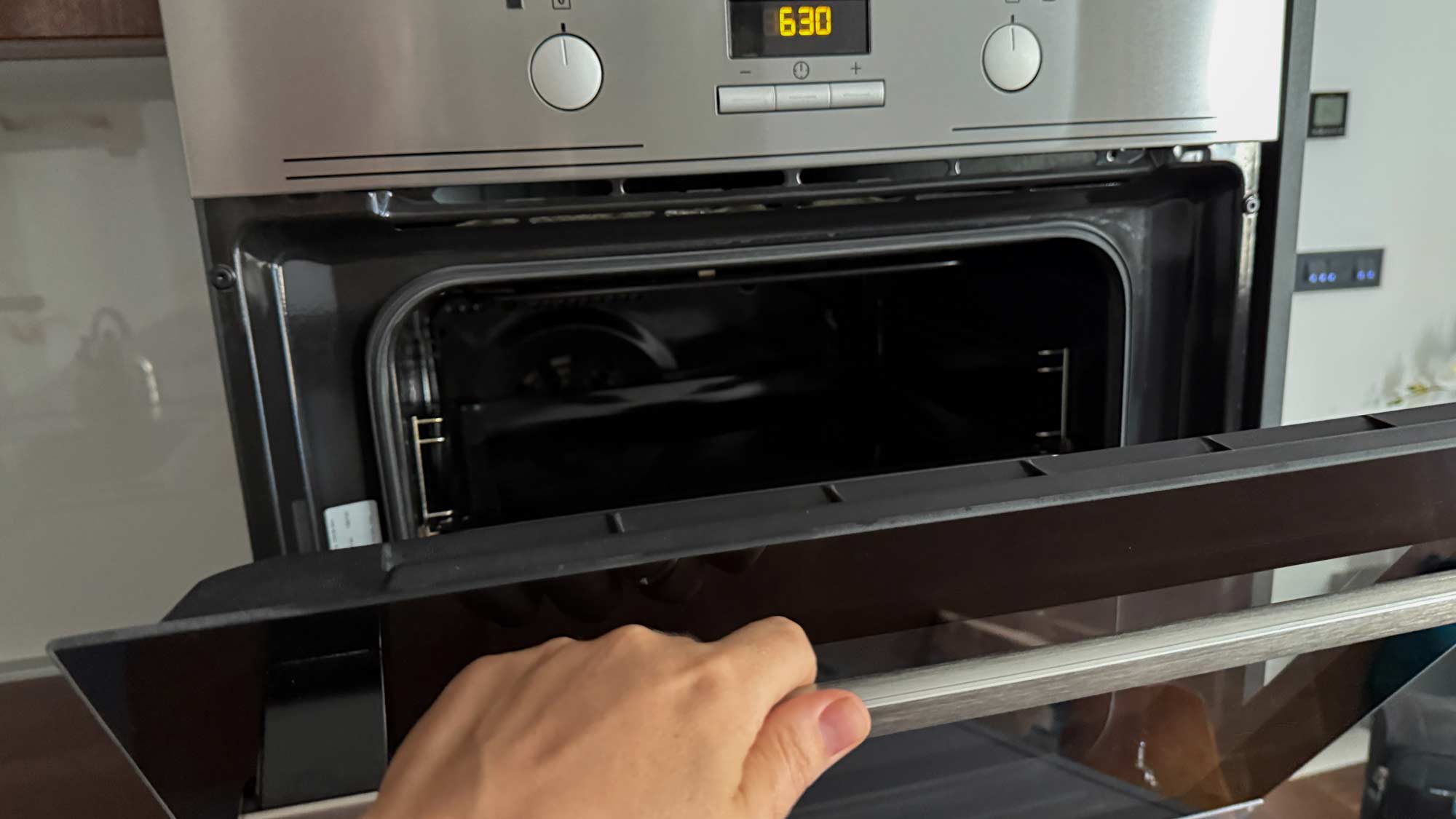
Open your oven door and have a proper look inside. Not a casual glance — actually look at the back walls, the bottom, behind the elements, and the glass door interior. That carbonised black layer coating everything? That’s burnt food, grease, and fat accumulated over months or years. Every time you switch the oven on, this residue releases smoke, unpleasant odours, and works against your cooking rather than with it.
Here’s what most people don’t realise: a properly clean oven looks almost new. The interior should be light grey or cream enamel, not black. The glass door should be transparent, not opaque with baked-on grease. Most households have never seen their oven in this state — they’ve owned it for years, occasionally wiped visible spills, maybe used supermarket oven cleaner once or twice, but they’ve never experienced what a genuine professional clean delivers.
Professional oven cleaners strip ovens back to near-original condition using specialist products, techniques, and equipment that simply aren’t available to consumers. They dismantle components, soak racks in caustic solutions, scrape carbonised deposits, and reassemble everything spotless — all whilst you do something more pleasant. This guide explains why it matters, how often you actually need it, what’s involved, and how to find someone worth hiring.
In This Guide
Why Professional Oven Cleaning Matters
Your food tastes better — genuinely
Carbonised grease doesn’t just sit inertly on oven walls. When it heats up, it releases smoke containing carbon particles and the chemical compounds of burnt fat. Fresh food cooked in a dirty oven picks up these flavours and odours whether you notice it consciously or not. You’ve probably become accustomed to it, but guests often clock it immediately. Bacteria can also survive in grease deposits, and food allergens can persist in burnt residue — both of which have obvious implications for households cooking for people with allergies or compromised immunity. A clean oven means food tastes exactly as it should.
Efficiency and energy costs
Carbonised deposits on oven walls and heating elements act as insulation, forcing the appliance to work harder to reach and maintain temperature. An oven in poor condition can be 10–20% less efficient than a clean one, taking longer to heat up and requiring higher temperature settings to achieve the same result. Over the course of a year of regular cooking, that inefficiency adds up on your energy bills. A clean oven heats faster, distributes heat more evenly, and uses less energy to do it.
Protecting an expensive appliance
A mid-range built-in oven costs £300–£800. A decent range cooker runs from £800 to well over £3,000. Accumulated grease and carbonised residue deteriorates oven components over time — seals break down, fan motors clog, thermostats lose accuracy, and oven glass can become permanently etched. Professional cleaning at £50–£80 every 6–12 months is sensible maintenance on an appliance that expensive. Most households that wouldn’t hesitate to service a car baulk at the idea of maintaining a cooker they use every single day.
The smoke alarm problem
Many households have simply accepted that the smoke detector goes off whenever the oven exceeds 200°C. This isn’t normal — it’s burnt residue smoking. A clean oven does not smoke (unless you are actively burning whatever you’re cooking). Professional cleaning eliminates this entirely, along with the persistent rancid smell that permeates the kitchen and sometimes the whole house whenever the oven is on.
How Often Should You Book a Professional Clean?
The oven cleaning industry broadly recommends the following as a baseline, though your individual habits matter more than generic guidance. Heavy users who roast and bake daily accumulate deposits far faster than someone who uses the oven twice a week at moderate temperatures.
| Usage Type | Typical Household | Professional Clean | Maintenance Between |
|---|---|---|---|
| Heavy (daily, high-temp, roasting) | Family of 4+, enthusiastic cooks | Every 3–6 months | Weekly wipe-downs |
| Average (4–5 times weekly) | Most UK households | Every 6–12 months | Fortnightly wipe-downs |
| Light (2–3 times weekly, lower temps) | Couples, singles, minimal cooking | Annually or every 18 months | Monthly wipe-downs |
| Rental property | Any tenancy | Between every tenancy | Annual top-up recommended |
Beyond scheduled cleans, certain signs mean a professional visit is overdue regardless of the calendar. If your oven smokes every time you use it, if you can no longer see through the door glass, if fat is dripping from the top or sides when heated, or if everything you cook has a faint burnt undertone — don’t wait for your next scheduled appointment. The same applies before significant cooking occasions: Christmas, dinner parties, or any time you’re cooking for people who haven’t become accustomed to the flavour your dirty oven adds to everything.
Oven Cleaning Cost Estimator
Get a realistic price range for your oven and region
Add-ons (tick if you want to include these)
See some of our contractors which are specialised in Cleaning



Realistic Costs Across the UK
The pricing below reflects what you can expect from a reputable professional using proper equipment. Budget significantly below these ranges is a warning sign — either they’re rushing the job or the final invoice will look quite different from the initial quote.
| Oven Type | London | South East | Midlands | North / Wales |
|---|---|---|---|---|
| Single built-in oven | £55–£90 | £50–£80 | £45–£75 | £40–£65 |
| Double oven | £75–£120 | £70–£110 | £65–£100 | £55–£90 |
| Range cooker | £100–£180 | £90–£165 | £85–£155 | £75–£135 |
| AGA / Rayburn | £140–£250 | £125–£230 | £115–£215 | £100–£190 |
Add-on services are commonly available alongside the main oven clean. A hob clean typically costs £10–£40 depending on size (range hobs with five or six burners take considerably longer). An extractor hood adds £15–£35. A microwave interior costs £15–£30. Many cleaners offer package discounts of 10–20% when you bundle services — worth asking about when you’re getting quotes.
Oven condition affects price significantly. An oven that’s been well-maintained and is booked in regularly will cost towards the lower end of the range. An oven that hasn’t been professionally cleaned in several years, with thick carbonised buildup, will take more time and chemicals — expect quotes towards the upper end or beyond, and be wary of any cleaner who doesn’t adjust their price after actually seeing the condition of the appliance.
What Actually Happens on the Day
A professional oven clean takes between 1.5 and 3 hours depending on oven size, type, and condition. Anyone quoting 30 minutes for a single oven is either extraordinarily optimistic or not planning to do it properly. The process should feel methodical and reasonably unhurried — this is what distinguishes a genuine professional from someone armed with supermarket spray.
Assessment and protection (5–10 minutes)
The cleaner examines the oven, identifies the model and construction, and discusses any concerns upfront — including staining that may not fully lift and any damaged enamel that cleaning will reveal but cannot repair. They’ll lay protective matting on the floor and counter around the appliance.
Dismantling (10–15 minutes)
Racks, trays, side panels, and removable components are taken out. The door is often removed entirely — this gives proper access to hinges and the areas around the seal. Don’t be alarmed; good cleaners do this routinely.
Dip tank setup and soaking (30–60 minutes)
Most professional oven cleaners use a portable heated dip tank — typically set up in the garden, driveway, or a protected indoor area. Racks and removable components are submerged in a heated caustic solution and left to soak whilst the interior cleaning takes place. This is the key distinction between professional and DIY: proper dip tanks cost hundreds to thousands of pounds and use chemical concentrations not available to consumers.
Interior cleaning (30–60 minutes)
Professional-strength cleaning solution is applied to the interior and left to dwell, breaking down carbonised deposits. Stubborn areas are carefully scraped with specialist tools designed to avoid scratching enamel. The back walls, base, behind elements, corners, and crevices all get attention. The glass door — often with two to four layers — requires accessing between the glass panels, which many less thorough cleaners skip.
Component cleaning and reassembly (10–20 minutes)
Racks are removed from the dip tank, scrubbed of any remaining residue, rinsed, dried, and polished. All components are reassembled, the door is reattached, and the exterior — including the control panel and any stainless steel — is cleaned and buffed.
Final inspection with you
A good cleaner walks you through the results, points out anything they weren’t able to fully restore, and offers maintenance advice. This is also when you should raise any concerns before they leave.
After a proper professional clean, the oven interior should have returned to something close to its original enamel colour — light grey or cream, not black. Racks should be recognisably silver again. The door glass should be transparent or at worst translucent. The transformation is usually quite dramatic, particularly on ovens that haven’t been professionally cleaned before. Some permanent staining may remain on very old ovens where burnt deposits have etched into the enamel over many years — honest cleaners will flag this before they start rather than promising a result they cannot guarantee.
How Often Should You Clean Your Oven?
Get a personalised cleaning schedule based on your usage
See some of our contractors which are specialised in Cleaning



How to Choose the Right Oven Cleaner
The clearest indicator of a genuine professional is their equipment and process. Ask specifically whether they use a heated dip tank for racks and whether they dismantle the oven including the door. If they answer confidently and in detail, that’s a good sign. If they’re vague, that tells you something too.
✓ Green Flags
- Specialist oven cleaning focus rather than general cleaning dabbling in ovens
- Heated dip tank system mentioned unprompted
- Explains the dismantling process clearly (door removal, panels, elements)
- Mentions cleaning between door glass layers
- Provides written quote with clear inclusions and exclusions
- Insurance certificate available on request
- Reviews specifically mention the before/after transformation
- Offers a satisfaction guarantee
⚠ Red Flags
- Dramatically cheap pricing (£20–£25 for a single oven is bait-and-switch territory)
- Vague about methods — will not say specifically what products or equipment they use
- Claims to clean pyrolytic self-cleaning ovens without any hesitation
- Quotes 30 minutes for a single oven clean
- No written quote — verbal prices that increase on arrival
- No insurance — unacceptable given the chemical and glass risks involved
- Door-to-door soliciting with high-pressure tactics
Always ask about insurance explicitly and request confirmation before work begins. Oven cleaning involves caustic chemicals, the risk of accidentally scratching enamel, and occasionally breaking oven glass. A reputable cleaner will have public liability insurance as standard — any hesitation or inability to provide proof is a reason to look elsewhere.
Special Situations Worth Knowing About
Pyrolytic (self-cleaning) ovens
Pyrolytic ovens incinerate residue by heating to around 500°C. They have a special catalytic enamel coating that enables this — and professional caustic cleaners can damage it. Many reputable professional oven cleaners will decline to clean a pyrolytic oven for exactly this reason. If you have one, tell any cleaner upfront to save wasted trips. Your options are to use the pyrolytic self-clean function (expect smoke, smell, and a locked oven for 2–3 hours), or find a specialist who explicitly and confidently cleans pyrolytic ovens and can explain exactly how they avoid coating damage. A cheap cleaner who simply says yes without engaging with the question is not the right choice.
AGA and Rayburn cookers
AGAs are a different proposition entirely. Multiple ovens, cast iron construction, always-on design, and specific cleaning requirements all mean that general oven cleaners who have only worked on domestic built-ins are not the right fit. Find someone with specific and demonstrable AGA experience — ask directly how many they’ve cleaned, and check reviews from AGA owners specifically. The cost reflects the complexity: £100–£250 is typical and represents specialist work rather than general cleaning labour.
End of tenancy
Letting agents inspect ovens at end of tenancy to a far higher standard than most tenants anticipate. Clean enough is not good enough — they expect near-new. When booking, be explicit that it’s end of tenancy and that you need it to pass a letting agent inspection. Experienced cleaners understand exactly what this means and will work to that standard rather than a general domestic one. Some provide certificates of cleaning, which can be useful if disputes arise. End of tenancy cleaning specialists often offer oven cleaning as part of a broader tenancy clean package, which is worth considering for the whole property.
Range cookers
Range cookers with two to four separate oven cavities and a large five or six-burner hob take significantly longer to clean than a single built-in oven. Ensure your quote explicitly covers all oven cavities — some cleaners price per cavity and this distinction should be clear before work begins. Expect 2.5–4 hours for a thorough job on a large range.
Maintaining Your Oven Between Professional Cleans
The single most effective maintenance habit costs nothing: wipe spills immediately, before they bake on. Fresh grease and food residue wipes away with a damp cloth. The same spill left until the next time you use the oven begins to carbonise, and within a few uses it’s a stubborn deposit that only professional intervention will shift. The difference between a household that gets 12 months between professional cleans and one that needs one every four months is often this one habit.
After Each Cook
- Let oven cool to warm
- Wipe any fresh spills with a damp cloth
- Takes 2–3 minutes
- Prevents 70% of future buildup
Weekly or Fortnightly
- Spray interior with mild oven cleaner or bicarbonate paste
- Leave 10–15 minutes, wipe clean
- Wipe racks with damp cloth
- 15–20 minutes total
Monthly
- Remove and soak racks (bicarbonate and hot water)
- Clean extractor filter whilst you’re at it
- Check and clean oven door seal
- 30–40 minutes
Oven liner sheets are worth considering — non-stick sheets placed on the oven base catch drips and spills and simply lift out for washing. They cost £5–£15 and significantly reduce base buildup. Replace them every 6–12 months or when they look beyond saving.
Common Myths Worth Addressing
The self-cleaning function works just as well as professional cleaning. It does not. The pyrolytic function incinerates organic matter but creates significant smoke and smell, uses enormous amounts of energy running at 500°C for 2–3 hours, stresses oven components, does not clean between the door glass layers, and requires racks to be removed first. Professional cleaning delivers better results without the energy cost or appliance stress. On ovens where the pyrolytic coating makes professional cleaning inadvisable, the self-clean function is the reasonable alternative — but on a standard oven it is not equivalent to a professional visit.
Supermarket oven cleaner works just as well as professional products. Consumer products are deliberately formulated to be weaker — they need to be safe to sell to the general public and store in kitchen cupboards next to food. Professional caustic cleaners are industrial-strength and would be genuinely hazardous if sold over the counter. The chemical strength difference is substantial, which is why DIY results are typically mediocre on heavy buildup however much elbow grease goes in.
Professional cleaning damages oven enamel over time. The opposite is true. Proper professional cleaning using appropriate tools does not damage enamel. What damages enamel is years of carbonised deposits etching the surface, combined with the abrasive DIY scrubbing people resort to when they try to tackle heavy buildup themselves. Regular professional cleaning is protective, not damaging.
It is expensive for what it is. A professional oven cleaner’s actual costs per job are significant: specialist equipment (a good dip tank system costs £500–£2,000), professional-grade chemicals (£10–£20 per job), public liability insurance, vehicle costs, and business overhead. After costs, profit per job is typically £25–£35. You’re paying for specialist equipment, expertise, and avoiding several hours of genuinely unpleasant chemical work.
Oven Cleaning Quote Analyser
Compare up to three quotes — find the best value, not just the cheapest
Frequently Asked Questions
How much does professional oven cleaning cost in the UK?
A single built-in oven costs £40–£90 depending on region and condition — London rates sit at the higher end, whilst Northern England and Wales are typically the most affordable. A double oven runs £55–£120, a range cooker £75–£180, and an AGA or Rayburn £100–£250 reflecting the specialist knowledge and time required. These prices are for a reputable professional using proper equipment including a heated dip tank. Significantly cheaper quotes usually indicate either a rushed job or a price that will increase once the cleaner arrives.
How often should I have my oven professionally cleaned?
For average households cooking four or five times a week, every 6–12 months is sensible. Heavy users who cook daily at high temperatures — particularly roasting — should look at every 3–6 months. Light users might comfortably stretch to 18 months, particularly if they wipe down regularly. Rental properties should be cleaned professionally between every tenancy as a minimum. Do not wait until the oven is smoking — by that stage it is significantly harder and more expensive to restore.
How long does a professional oven clean take?
A single built-in oven typically takes 1.5–2.5 hours. A double oven runs 2–3 hours, a range cooker 2.5–4 hours. The time depends on oven size, type, and condition — ovens with years of neglected buildup take longer than those cleaned regularly. If a cleaner quotes you 30 minutes for a single oven, they are either not planning to do a thorough job or they have not considered the dip tank soaking time required for racks.
Can professional cleaners clean a pyrolytic self-cleaning oven?
This is genuinely complicated. Pyrolytic ovens have a special catalytic enamel coating that enables the self-clean function, and professional caustic cleaners can damage it. Many reputable oven cleaners will decline pyrolytic ovens precisely because of this risk. If you have one, be upfront about it when getting quotes — a cleaner who says yes without engaging with the question should be treated with caution. The self-clean function is the appropriate cleaning method for most pyrolytic ovens.
Does professional oven cleaning include the hob and extractor?
Usually not by default — these are typically add-ons. A standard hob clean adds £10–£25, a larger range hob £20–£40. An extractor hood adds £15–£35. Many cleaners offer bundle discounts of 10–20% when you combine services, so it is worth asking when booking. Always confirm exactly what is included in the quoted price before work begins — any reputable cleaner will provide this in writing.
Do I need to be at home during the oven clean?
Yes — the cleaner needs property access throughout, and most use a portable dip tank that goes in your garden or driveway. You do not need to supervise closely, but you should be available to give access to the relevant areas and to walk through the results at the end. The process takes 1.5–3 hours for most domestic ovens, so plan to be in for that window. Some cleaners have dip tank equipment contained within their van, which reduces the outdoor space requirement.
Will professional cleaning remove all stains and burnt marks?
Most deposits and staining, yes. The transformation on heavily carbonised ovens is usually dramatic. However, very old burnt marks that have etched into the enamel over many years may leave permanent discolouration even after thorough cleaning — the residue is removed but the enamel surface itself has been altered. Scratched, chipped, or worn enamel similarly cannot be restored. Good cleaners will inspect the oven before starting and set honest expectations rather than promising a result they cannot guarantee.
What preparation do I need to do before the cleaner arrives?
Very little. Clear the area immediately around the oven, remove anything stored inside it or in the drawer below, ensure there is access to a sink for water, and make your garden or driveway accessible if the cleaner uses an external dip tank. That is genuinely it — total preparation is around 5–10 minutes. Do not pre-clean the oven beforehand; that is what you are paying for, and it wastes your time.
Find an Oven Cleaning Specialist Near You — Zero Commission
TraderStreet connects you directly with qualified local oven cleaning professionals. No platform fees, no middleman markup on your quotes. Compare profiles, read genuine reviews, and contact cleaners directly.
Find Oven Cleaners Near You →